I’m taking a course to learn to program (Python) and while reading the text and doing the coding exercises, there’s a part of my brain that feels like it’s ‘observing’ the part(s) of my brain trying to learn and do this new thing. Obviously I can’t really feel or observe new neural connections forming, but the contrast between other things I do without struggling as much (learning a language, problem-solving, business analysis, etc – ie: not the cotidiana (love that word, that and zopilote are my favorite Spanish words to randomly say out loud)) makes the effort to connect what I read to what I can (mostly can’t) do very striking. Continue reading
Author: la dama

Opportunity redux
So the previous post reflected something happening in my life and seemed perfect when I first found it.
But the fact that the words came from a general speaking about security from a conflict perspective made me think of war. War made me think of refugees and political prisoners (which the news tells us have reached numbers where our minds just sort of shut down instead of comprehending). Refugees and prisoners made me think about just what being a refugee or political prisoner might be like. Continue reading

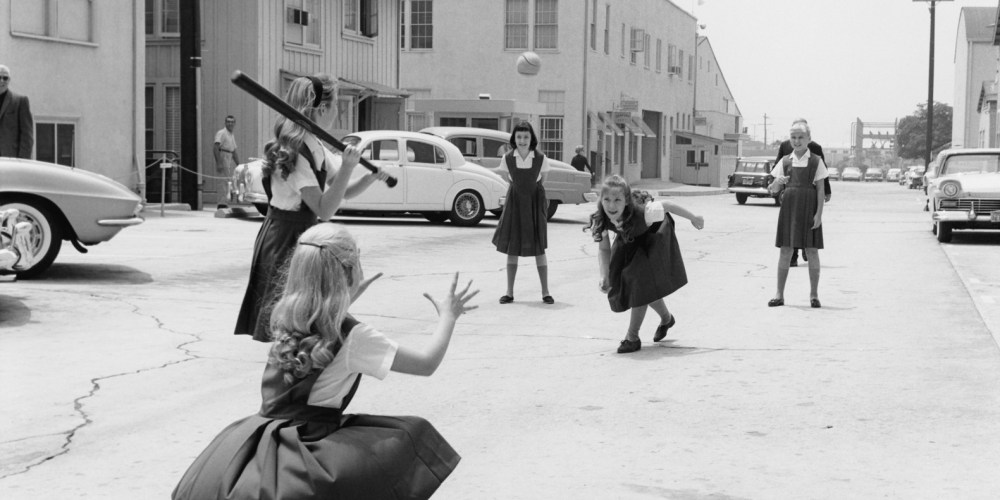
Batter, batter, batter, SWING!
Had the opportunity yesterday to watch a local, informal version of a ‘Shark Tank’ – where aspiring entrepreneurs pitch their start-up business plans to a panel of business-people (presumably who have launched successful start-ups – I missed the intros). The panel provides them with advice both on how to improve their pitch to investors/mentors and improve or address gaps in their business plans. Some observations on the user-experience (UX) of the judge-panelists: Continue reading
We feel an affinity with a certain thinker because we agree with him; or because he shows us what we were already thinking; or because he shows us in a more articulate form what we were already thinking; or because he shows us what we were on the point of thinking; or what we would sooner or later have thought; or what we would have thought much later if we hadn’t read it now; or what we would have been likely to think but never would have thought if we hadn’t read it now; or what we would have liked to think but never would have thought if we hadn’t read it now.
Blake and Steadman
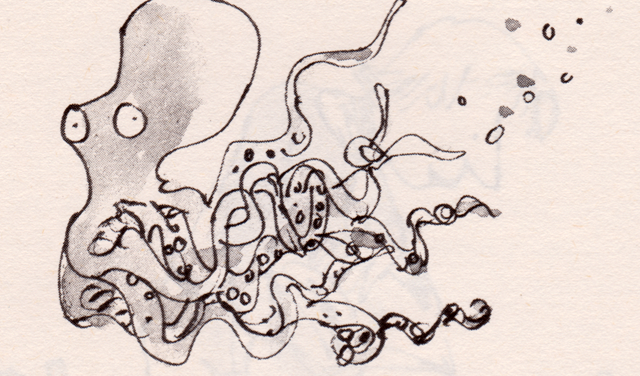
Illustration by Quentin Blake
I love how gloriously loose and messy the illustrations of Quentin Blake and Ralph Steadman are. And in the day of admittedly well-crafted but too meticulous (for my taste) Photoshop and Illustrator designs literally flooding the internet – I just can’t help but feel the Sanskrit emotion of ananda when looking at these ink-strewn images.
It may be due to reading so many Sid Fleischman books (illustrated by Blake) as a kid that imprinted this freewheeling style in my psyche.
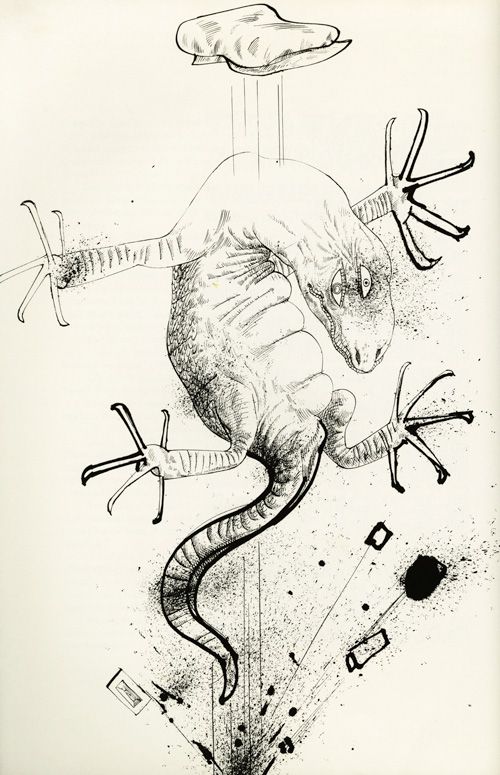
Illustration by Ralph Steadman
And, true to my liberal arts compare-and-contrast training, that quote from Ira Glass that’s been going around lately comes to mind, the one about having taste but the work not coming out how your mind’s eye saw it. The disappointment and desire to quit. A quick google of that quote reveals it’s not about one’s art looking/sounding perfect, but “hav[ing] this special thing that we want it to have.”
Perhaps therein lies the heart of the matter (hoo, there’s a new writer cliché at your service) – the Blake/Steadman illustrations have that special thing, that thing that’s missing when I see the meticulously crafted but oddly anonymous art and design online.
Here are two examples for your own ananda.
To code or not to code
A debate in the design/UX world has been, not raging, jostling? about in regards to whether design folks should learn to code. I’m pretty much of the mind that companies get more value from developers who can code well and designers who can design well vs trying to hire a person who does one thing well and the other well enough to get by. Continue reading
Tea and spirits
Thinking about how necessary it is for user experience (UX) professionals to be infused with empathy as part of their interactions in day-to-day life, and not just when on the job. A thoughtful post by another UX blogger talks about empathy too.
 Which led to thinking of tea infusions –
which seemed kind of a weak image (think tea vs. coffee, weak vs. strong). That led to thinking of distilled spirit infusions (all the rage in SoCal lately) and how that image conveys energy, a willingness to experiment, a joie de vivre (most likely due to the excited media coverage of this new foodie enthusiasm).
Which led to thinking, wait a minute, how many empires have been architected, built, plotted against, destroyed – in boardrooms, palaces, cottages and yurts all while participants sipped tea? Sure, we read about memorable events fueled by alcohol, but perhaps tea as a contributor to historic events has had a much greater influence (some of which recorded here). So too, perhaps for empathy. It doesn’t get the make a dent in the universe rock star status in the design world like other skills, but could its influence be greater?
How conflict management theory informs design
So I’m trying to figure out whether the profession of ‘designer’ or the label of ‘creative’ draws people of a certain temperament or the job itself draws out innate tendencies and amplifies them. Perhaps it has nothing to do with temperament or tendencies and is an evolving survival response to an economic environment where ‘at-will’ employment means competent people are let go from jobs as a matter of course.
Hi-Lo Fidelity in Context
I imagine over the centuries that practitioners of any craft have debated the absolute necessity or utter uselessness of various techniques and tools employed in their craft. The user-experience profession is no different. Recently the UX [insert social media of choice]-o-sphere has been bouncing around the topic of how to communicate a thing-that-doesn’t-yet-exist to a client or developer.
 melonknees